
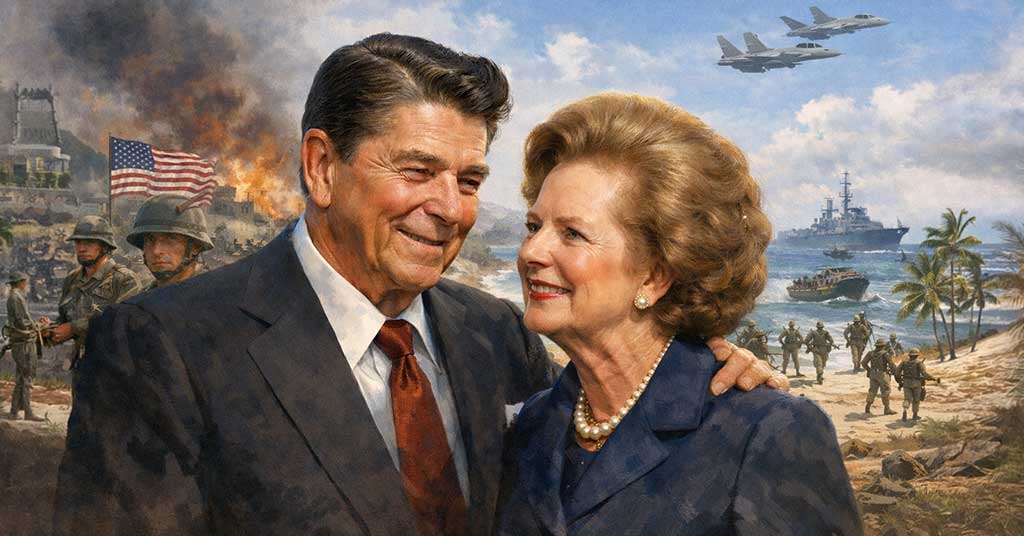
Reagan sidelined Thatcher by invading Grenada without consulting her but the relationship survived anyway

When Ronald Reagan and Margaret Thatcher first met in 1975, he was a former two-term Republican governor of California and she was the U.K.’s newly minted Conservative leader of the opposition. Both were clearly ambitious, but very few people would have been prepared to bet on what happened: she’d become prime minister, he’d win the U.S. presidency, and their relationship would help set the stage for the 1980s.
They hit it off right away, partly because of their political compatibility and partly because of their chemistry. On a personal level, Reagan was tall, dark and handsome, the sort of man that Thatcher was often drawn to. And his 1940s Hollywood good looks didn’t do any harm either. Thatcher, after all, had been an avid cinemagoer during her teenage years.
The first rough spot came with Grenada in 1983. Maurice Bishop, a Fidel Castro protégé, had seized power from the corrupt and violent Eric Gairy in 1979, suspended the constitution and launched what’s often described as a popular revolution. This didn’t sit well with the Reagan administration, which feared communist subversion in Latin America and—rightly or wrongly—viewed Bishop as a Soviet proxy.
Then Bishop was overthrown and murdered by a more radical Marxist faction, at which point the Americans invaded. In doing so, they were supported by the Organization of Eastern Caribbean States, Barbados and Jamaica. But despite the fact that Grenada was a member of the Commonwealth, Thatcher was effectively cut out of the decision-making process. Basically, Reagan didn’t want to give her a chance to “say no,” which is precisely what she’d have done.
Thatcher strenuously rejected any comparison between Grenada in 1983 and the Falklands a year earlier. Argentina had invaded the Falklands, but Grenada hadn’t invaded anyone.
Nor is there any indication that she was ever mollified by the fact that the American intervention was brief. The constitution was restored and democratic elections were held in 1984. And the intervention was apparently popular with Grenadians. When Reagan paid a short visit in 1986, he was welcomed as a hero.
Thatcher’s objections went beyond the principle of the thing. In addition to being humiliated, she felt betrayed. Her biographer, Charles Moore, puts it this way: “She liked Reagan … above all because he inspired her trust. In her mind, there was no greater virtue than trust.” Getting that back would be difficult.
Nonetheless, Thatcher continued to engage, taking the lead in promoting Mikhail Gorbachev as someone more promising than previous Soviet leaders. Eventually, that would lead to anxious moments and lively exchanges. It turned out that Reagan had a surprise in store.
Although not generally recognized as such at the time, he was actually a nuclear weapons eliminationist who regarded the prevailing orthodoxy of Mutual Assured Destruction (MAD) as “immoral.” In his ideal world, nuclear weapons would be rendered obsolete by his Strategic Defense Initiative (SDI), the technical details of which he proposed to share when it reached the point of operational viability.
Many people—Thatcher included—regarded this as hopelessly naïve. To them, SDI was both technologically unfeasible (at scale) and a potential destabilizer that would only promote a greater arms race. Besides, Reagan’s term in office was finite and there was no guarantee that successors would feel the same way about sharing.
Meanwhile, MAD was a proven deterrent that had kept the peace for decades.
This came into sharp focus when the idea of both sides eliminating their nuclear arsenals was briefly bruited during Reagan’s 1986 Reykjavik summit with Gorbachev. Given the Soviet advantage in conventional forces in Europe, Thatcher found such talk dangerous. In her mind, it had the potential to undermine popular support for what she regarded as essential nuclear deterrence.
Grenada notwithstanding, Thatcher remained Reagan’s political ally. For one thing, it allowed her to have influence. And although cognizant of his evolving age-related limitations, she still liked and admired him, particularly his strong convictions and effective communication skills.
To quote Moore again: “She truly believed that he was much better than any other likely leader of the free world … She had long ago put most of her eggs in Reagan’s basket, and found it sound, so there her eggs were going to stay, no matter what anyone said.”
This characteristic was particularly evident during the Iran-Contra affair. With Reagan’s personal morale at its lowest point, her public and private support is credited with helping him to “get back on his feet with some bounce left in him.”
As the Reagan-Gorbachev relationship developed and the Cold War thawed, Reagan saw to it that she got some of the credit. Speaking at London’s Guildhall in June 1988, he was effusive about her personal contribution. Terms like “firm, eloquent voice” and “valour and strength” testified to the high regard he had for her.
In the end, this is how Moore summarizes it: “The coincidence of such like-minded occupants of the White House and 10 Downing Street in power for eight years together had never happened before, and it has not happened since.”
Opinions vary over whether or not this was a good thing. But it was certainly consequential.
Troy Media columnist Pat Murphy casts a history buff’s eye at the goings-on in our world. Never cynical—well, perhaps a little bit.
Explore more on History, Cold war
The views, opinions, and positions expressed by our columnists and contributors are solely their own and do not necessarily reflect those of our publication.
Troy Media empowers Canadian community news outlets by providing independent, insightful analysis and commentary. Our mission is to support local media in helping Canadians stay informed and engaged by delivering reliable content that strengthens community connections and deepens understanding across the country.

