
One Canadian millionaire’s indie platform is quietly rescuing forgotten comic history
Who would have guessed that a print-on-demand publisher would be home to an unexpected surge of interest in old, long-forgotten comic strips?
That’s what is happening at Lulu Press, Inc., a privately held company with more than two decades of experience in book publishing.
Lulu was launched in 2002 by businessman Bob Young. He co-founded Red Hat Inc., a U.S.-based open-source software company which was purchased by IBM for US$34 billion in 2018. He was the CEO of PrecisionHawk from 2015 to 2017 and co-founded the monthly publication Linux Journal. He also served as Lulu’s CEO until 2021.
Young is also a well-known figure in Canadian sports. A native of Hamilton, Ont., he purchased the CFL’s Hamilton Tiger-Cats in 2003 and remains its largest shareholder. He also owns the Canadian Premier League’s Forge FC and operates Hamilton Stadium, previously known as Tim Hortons Field.
(A quick anecdote. I had a friendly debate with Young at CH News’s Square Off on Sept. 29, 2005. The topic? Whether the CFL or NFL was the superior product. That’s when I still had serious reservations about the calibre of Canadian football. How times have changed!)
The successful entrepreneur started Lulu because he wasn’t able to arrange a book deal by traditional means. “Our founder, Bob Young, discovered publishing his amazing story through any of the traditional publishing houses was impossible,” according to the company’s website. “Determined to share his story, he employed a hybrid publisher but was frustrated, disappointed, and dissatisfied with the nominal results. At this point, he determined no one should have to share a similar experience, and Lulu was born.”
Lulu’s print-on-demand model helps explain why it works for specialized projects with potentially small audiences. Rather than requiring hundreds or thousands of copies to be printed in advance, books can be produced individually as they are ordered. Creators using Lulu remain the publishers of their work while the company provides the technology, printing and fulfillment. That makes it possible to publish highly specialized books without requiring a conventional large print run.
Lulu had reportedly published over two million book titles by 2014. This number has continued to increase on an annual basis. A case study published by David van Driessche for the PDF Association on July 9 suggested “Lulu users publish around 350,000 books per year, or roughly 1,000 books per day,” with an estimated “75 per cent of its business is in the United States, but the platform serves customers internationally and produces books as close as possible to the buyer.”
This includes comic strips, comic books and graphic novels. Lulu has published plenty of these volumes over the years. One notable example was the first collection of Aaron Johnson’s What the Duck, which started as a webcomic and was later picked up by Universal Press Syndicate and rebranded W.T. Duck.
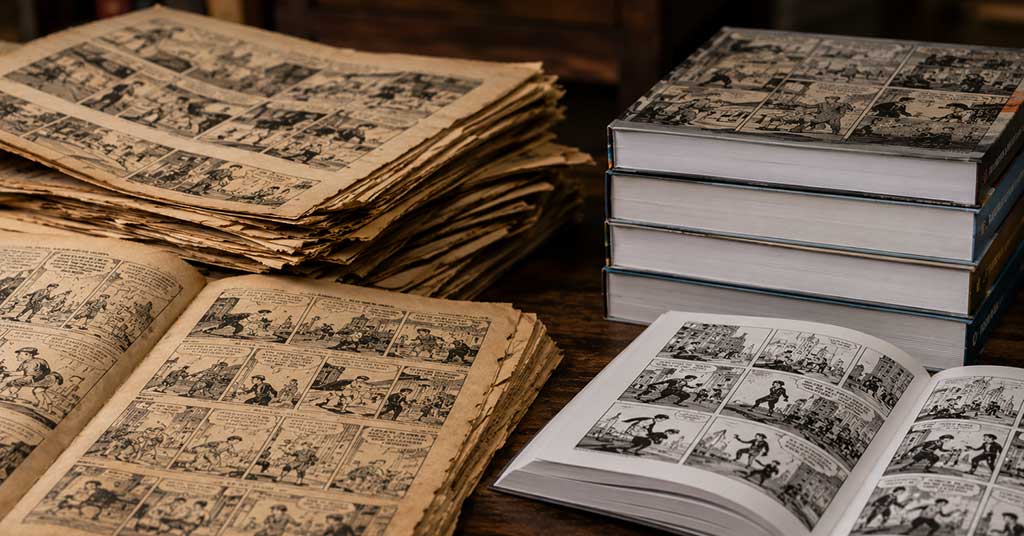
The publication of older comic strips in the public domain on Lulu has really taken off in recent years. Here are a few examples.
Tom Heintjes, editor of the well-respected Hogan’s Alley magazine, produced a superb book, The Complete Betty Brown, Ph.G., in 2024. This little-known strip, which appeared in a trade publication called Drug Topics from 1934 to 1948, was the first example in the comics of a female professional who owned and worked in a drug store. Betty faced everything from mobsters to con men, and still found some time to pursue romantic adventures. Heintjes’s exceptional writing and editing ensured this strip, which contained subtle dashes of Dick Tracy and Li’l Abner, would never hide in obscurity again.
The Comic Strip Appreciation Group has published multiple volumes on Lulu. I recently purchased Railroad Red, a little-known strip created by David Marshall and Beaumont Fairbank that barely appeared in any newspapers during its short 10-month run in 1941. That’s a real shame: the story of Red Greene, a crime-fighting detective on the railways, is a well-drawn, well-written and well-done strip. Had there been a larger audience for Railroad Red, it could have had a much lengthier and more acclaimed run. What little was produced can now be widely read and permanently savoured.
Two other exquisite books focus on the early history of a strip that later evolved into the adventures of a spinach-eating sailor.
Kurtis Findlay, the online communications coordinator at the Library of American Comics, just released his first volume of E.C. Segar’s Thimble Theatre. It’s a collection of the 1919 to 1920 dailies of this brilliant strip that focused on Olive Oyl, her brother Castor Oyl and her then-boyfriend Ham Gravy. This gag-a-day feature was very different from the environment that Popeye, Wimpy, Bluto, Swee’Pea, Alice the Goon and others would eventually dominate. Findlay is already off to a terrific start, and the next eight volumes in the series should be good fun to read.
Frank Tovar, a writer, director and filmmaker, has started his three-volume series on a specific storyline from Thimble Theatre featuring Castor Oyl. The first volume of “The Saga of Cylinda Oyl” largely focuses on Olive’s diminutive brother and the woman who would eventually become his wife. Tovar has an excellent essay about Segar and Thimble Theatre, complete with photos and artwork. While there will be some crossover with the Findlay series, it’s a unique entity that can easily be collected on its own.
Thanks to Young’s original vision for Lulu, a new avenue for old comic strips has been unexpectedly established. A wealth of knowledge is readily available for purchase and consumption, and there will surely be more books to come.
Michael Taube is a political commentator, Troy Media syndicated columnist and former speechwriter for Prime Minister Stephen Harper. He holds a master’s degree in comparative politics from the London School of Economics, lending academic rigour to his political insights.
Explore more on Comics, Culture
The views, opinions, and positions expressed by our columnists and contributors are solely their own and do not necessarily reflect those of our publication.
Troy Media empowers Canadian community news outlets by providing independent, insightful analysis and commentary. Our mission is to support local media in helping Canadians stay informed and engaged by delivering reliable content that strengthens community connections and deepens understanding across the country.

